
Press Kit


Moonshades Press Release
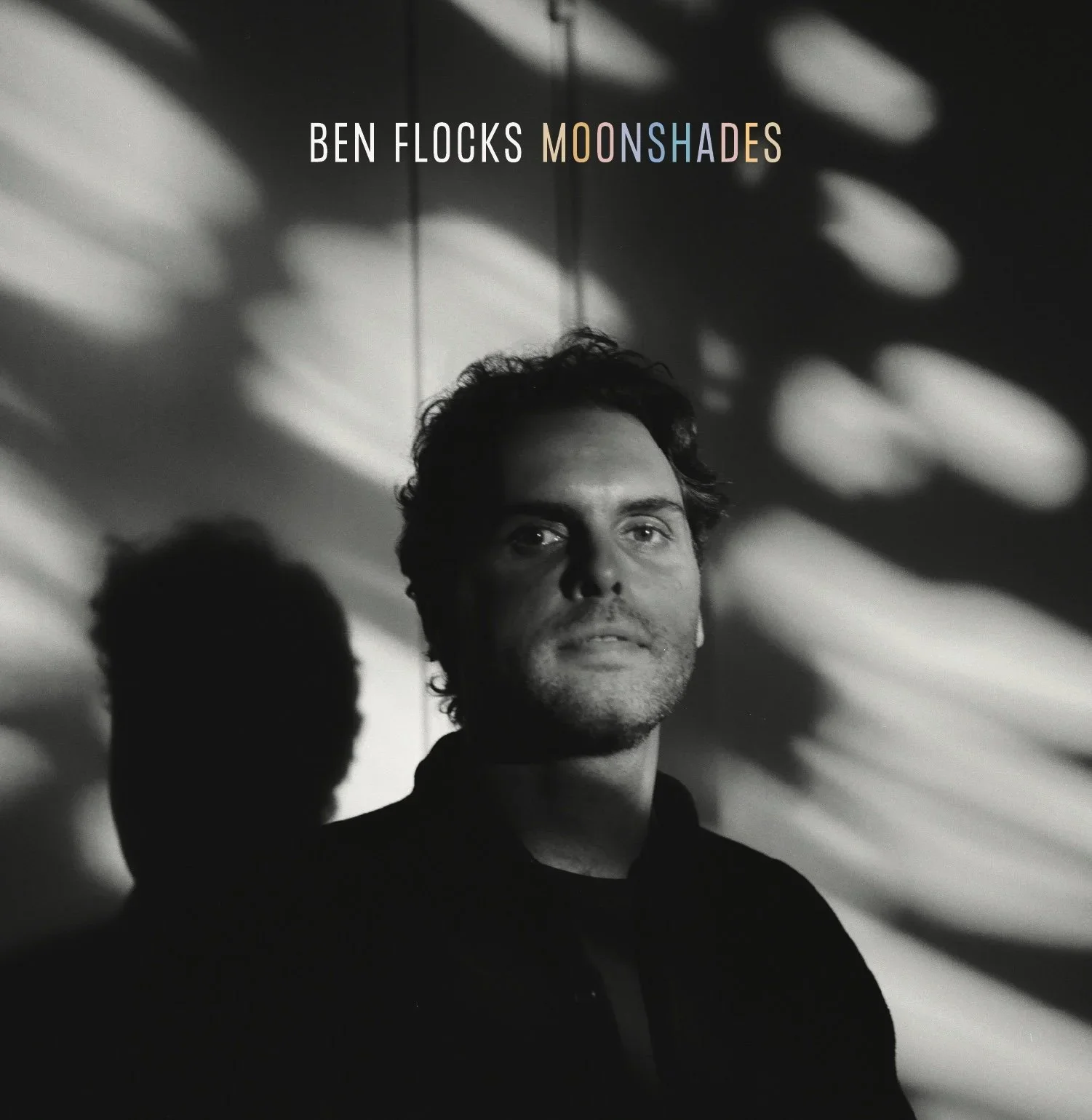
While the moon impartially orbits our chaotic home from a quarter of a billion miles away, its sporadic glow has always enchanted civilization. For Ben Flocks and his newest release Moonshades (April 10, 2026), the moon is a reminder of the unknowable and the spirit of searching. Across twelve tracks of standards and originals, Flocks places his patient saxophone in the center of the album’s orbit. “The moon opens up my mind,” says Flocks. “It rewires my brain. The moon inspires all these different emotions in people and that was something I wanted to explore through this record. Through the moon, I was able to discover things that I was trying to express, ideas that I didn’t know that I was feeling.”
Growing up in the Santa Cruz mountains, Flocks witnessed lunar grandeur over the churning Pacific surf and filtered through redwood canopies that house infinite ecosystems. In Stockton, California, he spent time at the Brubeck Institute where he performed with Dave Brubeck and gained infinite inspiration from his music and his legacy. After, Flocks spent more than a decade in New York City leading his own bands at the 55 Bar and Cornelia Street Cafe. These days Ben is grounded in Los Angeles where the sprawling metropolis lights often cancel out all but the moon in the night sky. “In New York, you are consumed by humanness and civilization but in California, when you are out in nature and can see the moon, you realize there is so much more to this life.”
Moonshades is Flocks’ third album as a leader. At its foundation it’s a trio record, acutely aware of the history of saxophone triumvirates led by his heroes such as Sonny Rollins, Joe Henderson, and Joshua Redman, but concerned with an entirely different avenue thanks to bandmates Garret Lang (bass) and Jay Bellerose (drums). While those trios relished dexterity and unrelenting momentum, Flocks and his compatriots linger in the openness and unhurried propulsion that comes so naturally to them.
“Garret is one of my closest musical counterparts,” says Flocks. The collaborators first met in high school and have continued to cross paths from coast-to-coast with Lang’s bass appearing on Flocks’ debut Battle Mountain (2013) amid his versatile low end appearances with singer-songwriter Matt Berninger and swinging drum legend Albert “Tootie” Heath.
Jay Bellerose, a drum legend in his own right, entered into Flocks’ orbit not long after the release of his second album, Mask of the Muse (2019) where he joined the saxophonist on his West Coast performances at venues such as Los Angeles’ Blue Whale and the Monterey Jazz Festival.
Flocks notes, “from the first time I heard Jay, I knew he was someone I wanted to play with. I’ve done everything I could to be around him and I’ve learned so much from him.” Bellerose’s work with chart-topping songwriters like Elton John, Paula Cole, and Alison Krauss brings a dedication less to straight-ahead swing than a protean, percussive cushion that propels with ease.
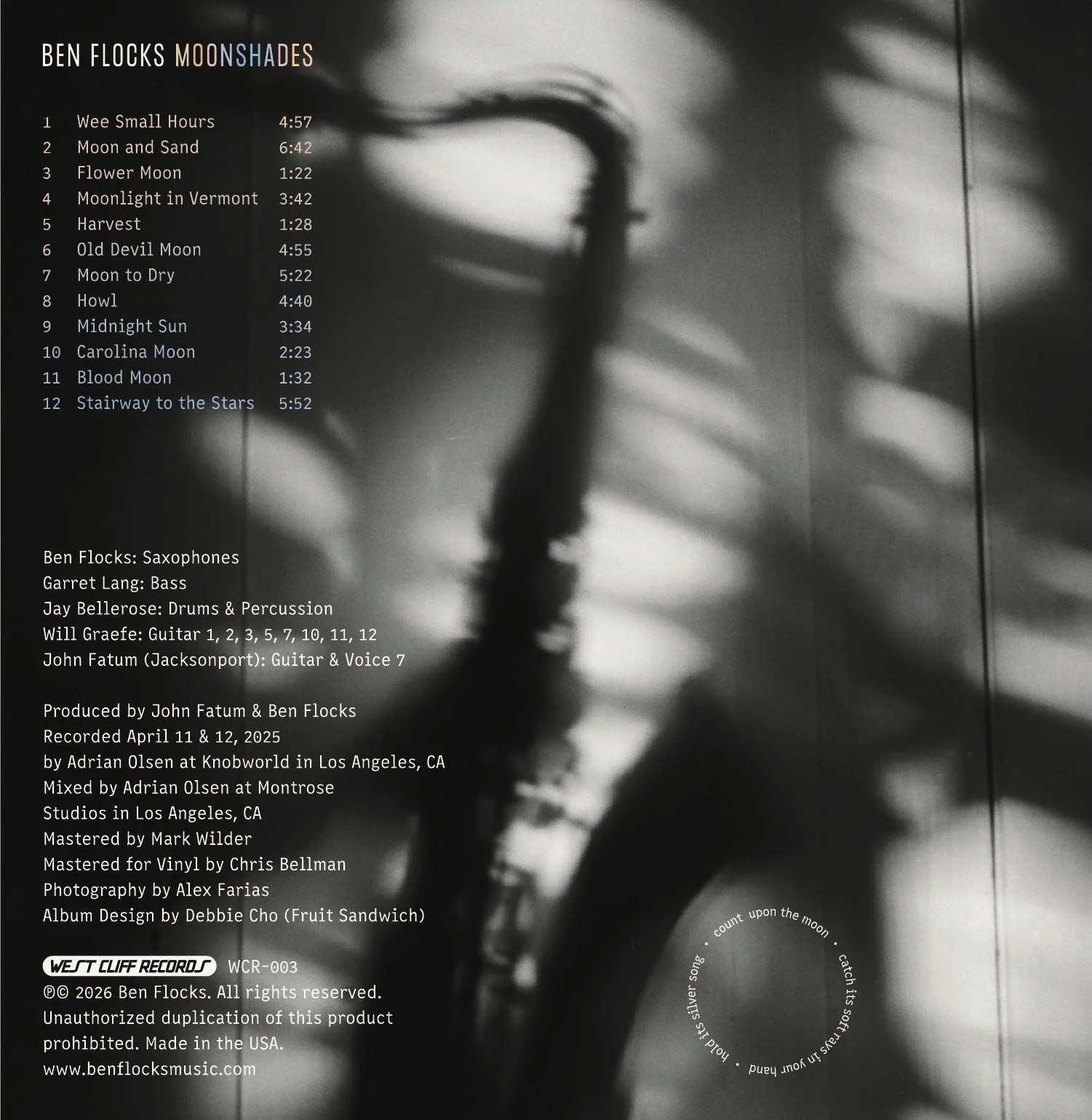
On Moonshades, Flocks interprets songbook standards amid improvised studio explorations. Building on the trio foundation, the opening track “(In the) Wee Small Hours” features guitarist Will Graefe, whose unadorned openness contributes to the mood that pervades the subsequent eleven tracks. “Will’s concept and sense of melody and song really stand out to me. It was beautiful to explore a newly developing musical dynamic with him” says Flocks. Here he favors thoughtful plucking that is baroque and contemplative, flowing gently against Lang’s spacious bassline. Strict time rarely pushes forward with each musician contributing their own unhurried parts to the Frank Sinatra standard. The Xavier Cugat-affiliated “Moon and Sand” gets a gentle churn that highlights Flocks’ soprano saxophone sound and Graefe’s patient lines, while mid-1940s standards “Moonlight in Vermont” and “Old Devil Moon” settle into a lilting swing in constant service to the original melody. “Often when we play, Jay and Garret set the mood with their perspectives and groove. I like to let them start the song or choose a tempo and then I can settle in to where they are.”
With sound capturing assistance from engineer Adrian Olsen, Flocks and his bandmates entered the studio willing to go where their music pulled them. “I didn’t over-plan,” says Flocks. “We didn’t rehearse for the record. I like making music that is new and spontaneous. I wanted to capture those moments where we didn’t know where we were exploring. Everyone in the band is such a deep listener which allows us to venture into uncharted territory.”
Collective improvisations such as “Flower Moon,” “Harvest,” “Howl,” and “Blood Moon” exemplify that anything goes approach, deviating from more familiar songs to present the band rolling with the tide, nimble and buoyant, the connective tissue holding the Moonshades mood together. Flocks explains, “Jay said that our improvisations sound like songs, while our songs sound like improvisations, and I think that’s a perfect window into our group dynamic.”
Co-producer John Fatum not only lent his ears to the production but also his voice. “John is one of my closest friends and he was a big inspiration for the record. He pushed me to organize my ideas and get back in the studio. I couldn’t have done it without him.” Fatum provides the lone vocal part on “Moon to Dry,” an ethereal interpretation of his own composition under the name Jacksonport. Amplified by Flocks’ soulful interjections, the song finds a tone reminiscent of Nick Drake’s drifting ballads.
Throughout Moonshades, Flocks creates an easy-going but complex groove. He presents a maturity and patience that is uncommon in young saxophonists. His awareness is everywhere on this record and he has surrounded himself with an equally attuned band. “The moon makes me wonder and it can make me sad. Sometimes it helps me to relax. For a long time the moon’s force was something that I wasn’t necessarily in tune with. The moon impacts everyone here on our planet and it has inspired so many different songs, stories, and moments. Through exploring the moon’s beauty and mystery I learned more about myself. It reminded me that we all must find our muse, and make meaning out of what we can in this world.”